Different ground intervals
Ask how the proposed method handles each interval and whether casing or a method change is required.
Applications / Water wells
Plan the completed well. Then match the drilling system.
RigSpan application planning · Reviewed 17 October 2026
Choose water well drilling equipment around the planned borehole, ground conditions, casing programme and site access. Compare the rig together with its air or mud system, drill string and completion scope. A catalogue depth rating does not establish groundwater yield or drinking-water quality.
The questions below are RigSpan procurement guidance. Record unknowns as unresolved so the supplier can state the assumptions behind its proposal.
| Requirement | Your project information | What to confirm |
|---|---|---|
| Water-supply objective | Intended use, required demand, existing well logs and water-quality information | Have the project specialist define the investigation and acceptance plan; keep water production separate from rig capacity. |
| Borehole and completion | Target depth, changing hole diameters, casing / screen sizes and proposed completion | Ask which drilling and casing stages the offered equipment supports. |
| Ground and circulation | Ground report, unstable intervals, water availability and proposed air or mud method | Confirm rig / hammer / compressor or rig / pump / fluid-system compatibility. |
| Access and relocation | Working area, road width, transport limits and relocation frequency | Compare crawler, trailer or other mounting against an actual transport and working layout. |
| Existing equipment | Compressor or pump model, operating data, rods and thread drawings | Identify reusable items and verify interfaces before excluding them from the quotation. |
| Completion and handover | Development, pumping-test, water-quality and completion-record responsibilities | Identify who performs each service and what is included in equipment supply. |
Ask how the proposed method handles each interval and whether casing or a method change is required.
Compare access, relocation and the full working layout; mounting type alone does not establish drilling suitability.
Add the hole / casing programme and available ground information before asking for a final configuration.
The UNICEF / Skat toolkit treats siting, construction, supervision and pump supply as defined project responsibilities. For an equipment purchase, use that distinction to identify which tasks belong to your drilling contractor, hydrogeologist, pump supplier and equipment supplier. RigSpan coordinates sourcing; a rig quotation does not include borehole siting or construction services unless the written scope says so.
Reference: UNICEF / Skat Foundation, 2018 — Borehole Drilling toolkit, RWSN publisher library
WHO provides a sanitary inspection package covering contamination risks and ongoing management of motorized-pump boreholes. Ask the project team to document completion protection, monitoring and maintenance responsibilities. Selecting a deeper-rated rig is not evidence that the completed water supply is safe.
Reference: WHO — Sanitary inspection package: borehole with a motorized pump
For an air-DTH proposal, request the actual hammer operating data, delivered compressor flow at the proposed pressure, drill-pipe connections and flushing assumptions. For a mud proposal, request the pump duty, drive, lines and fluid-handling scope. Epiroc explains why hammer size, depth and back pressure matter to compressor selection; its published machine ratings do not transfer to these catalogue rigs.
Reference: Epiroc — Surface Drilling reference book, compressed air for drilling equipment, page 96
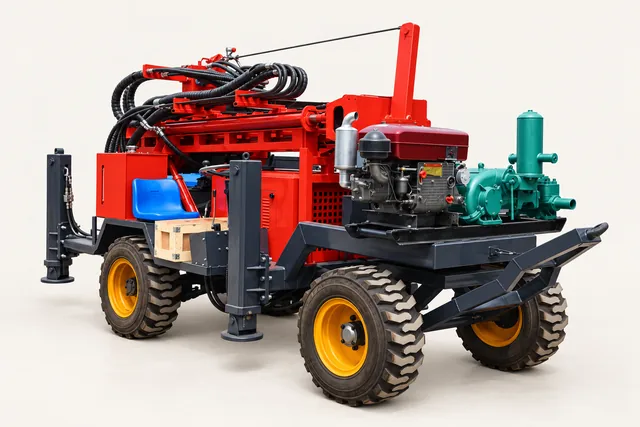
These are starting points for a supplier review, not a confirmed recommendation for every project. Open each product for its source-linked specifications, unresolved fields and configuration sheet.
The 200 m trailer listing describes air-DTH or mud options; the selected offer must identify the actual system.
Review specifications and evidence →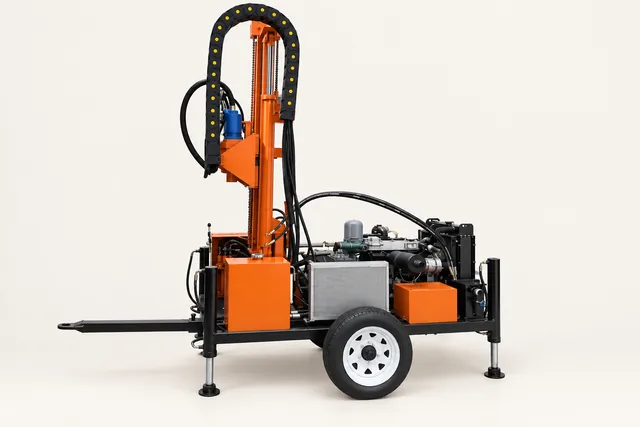
ST300 dimensions are supplier-labelled packing size. Obtain a current packing drawing and total accessory schedule.
Review specifications and evidence →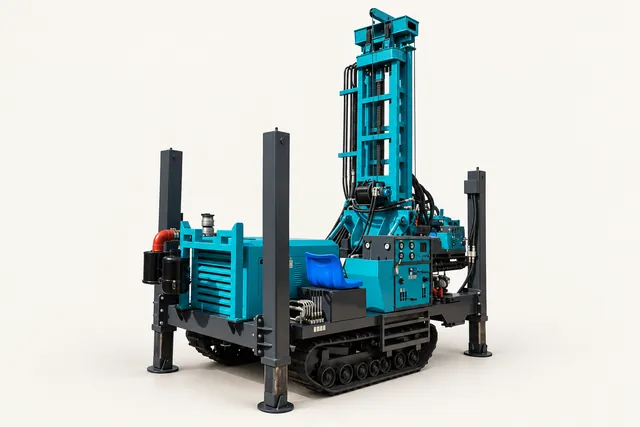
The 400 m crawler listing gives an air consumption range; match the actual hammer and duty rather than treating that range as a complete compressor selection.
Review specifications and evidence →Separate the machine, tooling, auxiliaries, spares and delivery scope. Mark every line included, optional, excluded or unresolved.
No. A listed equipment capacity is conditional on the drilling configuration and ground. The project investigation and completed-well testing address groundwater availability and performance; neither yield nor water quality follows from the rig label.
Only if the accepted quotation itemises it. Record the model, operating duty, hoses, connections, lubrication and other supporting items separately. Pump supply, well development and testing also need an explicit scope.
Reviewed 17 October 2026. General references explain the planning considerations stated above. The supplier listings below support only their own catalogue configurations and are not independent tests. The project brief and comparison questions are RigSpan editorial guidance; final engineering and acceptance requirements remain project-specific.
RigSpan coordinates equipment sourcing with manufacturing partners. Send the brief and identify any existing equipment; request a written configuration and scope before ordering.